
Avoiding the Travel Ban: Why Late Filers Face International Mobility Risks in 2026
In the increasingly documented economy of 2026, the Federal Board of Revenue (FBR) has moved beyond simple financial penalties to implement “mobility-based enforcement.” For the residents of Pakistan, particularly the frequent travelers and business elite of Karachi and Islamabad, the consequence of missing tax deadlines has escalated from a monetary fine to a potential restriction on international movement. The “Filer Revolution” has reached a stage where your passport’s validity in the eyes of the state is now inextricably linked to your status on the Active Taxpayer List (ATL).
With the professional roadmap established by Mohsin Ali Shah and Sobia Mohsin Shah, this guide explores the new regulatory environment where late filing is no longer just a fiscal oversight—it is a risk to your global mobility. Understanding the legal triggers that can lead to a travel ban is the first step toward securing your personal and professional freedom in 2026.
The Legal Mechanism: Section 192A and International Restrictions
The 2025-26 fiscal year has seen the rigorous application of enforcement powers that allow the FBR to coordinate with the Federal Investigation Agency (FIA) and immigration authorities. Under the current legal framework, persistent non-compliance or significant “unexplained wealth” can trigger a process that restricts a taxpayer from leaving the country.
The Trigger Points for Mobility Restrictions
In 2026, the risk of a travel ban typically arises in three specific scenarios:
- Persistent Non-Filing: Missing three consecutive income tax return filing deadlines can lead to a “Show-Cause” notice for the suspension of travel documents.
- Significant Tax Arrears: If a taxpayer has a confirmed tax liability (post-appeal) exceeding a specific threshold and has not made arrangements for payment, the FBR can request their placement on the Exit Control List (ECL) or the more frequent “Provisional National Identification List” (PNIL).
- High-Value Discrepancies: Individuals flagged by AI-driven systems for luxury international travel that is completely inconsistent with their filed income may face temporary “Stop Orders” until their wealth is reconciled.
By engaging with professional income tax lawyers, you can ensure that your filings are not just timely, but robust enough to withstand the “Lifestyle Audits” that precede these mobility restrictions.
The Cost of Late Filing: A Financial and Personal Comparison
Late filing (filing after the September 30th deadline) places you in a “Grey Zone.” While you may eventually appear on the ATL after paying a surcharge, you remain a high-risk profile for the FBR’s automated enforcement systems.
Category | Active Filer (On Time) | Late Filer (After Deadline) | Non-Filer (Unregistered) |
ATL Status | Immediate & Active | Active (After Surcharge) | Inactive |
Withholding Tax | Standard (Low) | Standard (After Surcharge) | 100% Surcharge (Double) |
Audit Probability | Low | Moderate | High (System Flagged) |
Travel Risk | None | Conditional Scrutiny | High Risk of Stop Orders |
Banking Ease | Full | Full | Transaction Blocks |
Strategic Wealth Reconciliation to Ensure Mobility
The key to avoiding “Stop Orders” at the airport is ensuring that your international footprint is supported by your financial declarations. In 2026, the FBR’s Iris 2.0 is directly integrated with the Integrated Border Management System (IBMS). This means every time you exit or enter Pakistan, the FBR knows the destination, the class of travel, and the estimated cost.
Mastering the “Travel Reconciliation”
Visionary income tax return filing in Pakistan now includes a dedicated “Travel & Leisure” reconciliation. We help our clients:
- Document Business Travel: Ensuring that tickets paid for by a company are correctly reflected as “Employer-Provided Benefits” rather than personal expenditures.
- Explain Luxury Vacations: Matching high-end travel costs against “tax-paid” income or documented “Gift Inflows” from family members.
- Maintain ‘Filer’ Integrity: Ensuring that even if you are abroad, your annual income tax return filing in Karachi or Islamabad is performed on time to avoid being moved to the “Non-Active” list while you are in transit.
Regional Enforcement: The Karachi Hub and Export Mobility
Karachi, as the center of Pakistan’s international trade, sees the highest volume of business travel. For the Karachi business elite, a sudden travel ban can result in lost contracts, missed exhibitions, and damaged global reputations.
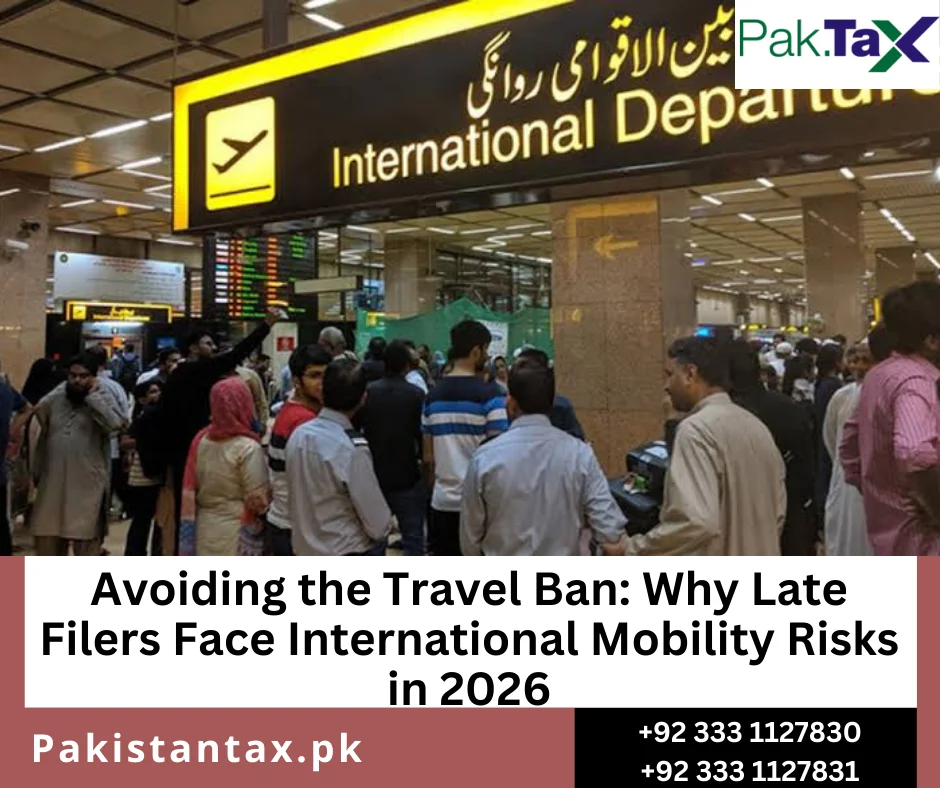
The Large Taxpayers Office (LTO) Karachi has a dedicated “Mobility Monitoring Cell” that specifically reviews the travel patterns of directors and high-net-worth individuals. We specialize in providing “Mobility Audits” for our Karachi clients, reviewing their tax profiles to ensure they meet every criterion for unrestricted international travel before they head to Jinnah International Airport.
How to Remove Your Name from a Restriction List
If you have already been flagged or restricted, the path to restoration is purely legal.
- Immediate Compliance: Filing all overdue returns and paying all outstanding taxes and surcharges.
- Legal Representation: Your lawyer must file a “Stay Order” or a “Compliance Certificate” with the Commissioner and the relevant border authorities.
- Appellate Tribunal Intervention: In cases of arbitrary bans, we approach the Appellate Tribunal Inland Revenue (ATIR) to challenge the restriction on constitutional grounds.
The expert oversight provided by Mohsin Ali Shah and Sobia Mohsin Shah is focused on “Pre-emptive Protection”—ensuring you never reach the point of a travel restriction in the first place.
Frequently Asked Questions (FAQs)
Q: Can the FBR really stop me at the airport for not filing taxes?
A: In 2026, the answer is yes. Under Section 192A and the coordinated efforts with the FIA, the FBR can place significant tax defaulters or persistent non-filers on lists that trigger a “Stop” at immigration.
Q: What is the ‘Late Filer Surcharge’ for 2026?
A: For individuals, the surcharge to appear on the ATL after the deadline is PKR 1,000. For companies, it is PKR 10,000. However, paying the surcharge does not automatically remove a travel ban if one has already been issued for tax default.
Q: Does frequent international travel trigger a tax audit?
A: Frequent travel to luxury destinations is a high-risk parameter in the FBR’s Risk-Based Audit Management System (RAMS). If your travel costs exceed your declared income, you will likely receive a “Notice for Explanation of Source.”
Q: I am an Overseas Pakistani; does this travel ban apply to me?
A: Generally, no, provided you have declared your “Non-Resident” status correctly in your filings. However, if you have a local NTN and have failed to file your “Statement of Foreign Income,” you could face issues when attempting to leave Pakistan.
Q: How can I check if there is a travel restriction on my CNIC?
A: While there is no public “Travel Ban” portal, you can check your Active Taxpayer Status on the FBR website. If your status is “Inactive,” you are at an increased risk. For a full check, a legal inquiry through the FIA or FBR is required.
Q: How do Mohsin Ali Shah and Sobia Mohsin Shah help with ‘Mobility Protection’?
A: They perform a “Pre-Travel Compliance Check,” ensuring that your Iris 2.0 profile is 100% reconciled with the FIA’s travel data, preventing any surprises at the immigration counter.
Q: Can I pay my taxes at the airport to avoid a ban?
A: No. The airport does not have the facility to process tax reconciliations or remove names from the ECL/PNIL. These matters must be settled at the FBR Regional Tax Office (RTO) or in court weeks before your flight.
Q: What is the difference between ECL and PNIL?
A: The ECL (Exit Control List) is for serious legal/criminal matters. The PNIL (Provisional National Identification List) is a more fluid list used for regulatory compliance, including tax default, and can be updated more frequently by the FBR.
Q: If I am a ‘Late Filer’, am I safe from the travel ban?
A: You are safer than a non-filer, but late filers are still subject to “Lifestyle Monitoring.” If you file late every year, the system may flag you for a “Manual Audit,” which is the precursor to a travel restriction.
Q: What is the first step to take if I am stopped at the airport?
A: Do not attempt to bribe or argue with immigration. Contact your tax lawyer immediately to obtain a “Notice of Compliance” or to file an urgent petition in the High Court for the restoration of your mobility rights.